By: Caitriona Dempsey
Coffee is an essential part of my morning ritual. There’s something about a takeaway coffee that makes it taste better than anything I could make myself (let’s forget about the fact that that’s probably because I don’t have a machine and use instant coffee). No matter where you are, especially in Dublin City Centre, you’re never too far from a coffee shop, and thus disposable cups. Dublin recently ranked the second most “coffee-obsessed” capital with 81 coffee shops per 100,000, surpassing the likes of London and Paris. In a 2023 survey, 27% of people reported buying at least three takeaway coffees a week, costing €468 a year. 4% buy nine or more a week, totaling €1,404 per year. But there is a hidden cost to the city’s takeaway coffee habit.
A 2018 study revealed that over 22,000 coffee cups are disposed of every hour in Ireland. But most people don’t consider the impact of this simple daily choice. While many coffee shops have switched from plastic cups to paper and opted to use cups clearly marked with recycling and green-friendly symbols, much of this is performative. Few coffee shops separate their plastic, paper, and landfill waste and for those that do, many don’t provide the same options for customers. Also, most paper cups can’t actually be recycled. This is because of a thin plastic layer that lines the inside. Ireland’s recycling mills do not currently have the infrastructure to separate these two materials. Coffee cups labelled compostable also require commercial composting and do not simply disintegrate when they reach landfill after being disposed of in the normal bin. As a result, millions of coffee cups end up in landfill or incineration plants in Ireland each year where they take approximately 20 years to decompose or are burned, both processes emitting substantial carbon dioxide concentrations, a.k.a greenhouse gas into the air.
We have also seen the rise of ‘Keep Cups’ in recent years with many coffee shops offering financial incentives and deposit return schemes to incentivize customers to use a reusable cup. This can be seen in Bread 41 on Pearse Street where customers pay a €5 deposit to receive their takeaway coffee in a reusable cup, if they do not bring their own. The cup can then be returned later in exchange for the deposit back. While a worthy endeavor, the reality is that these cups need to be used between 20 and 100 times to have any environmental benefits, and many of them end up piling up in people’s homes or being discarded. This is particularly damaging when these reusables can contain up to 145.6 times more plastic than a disposable alternative. There are also significantly higher carbon dioxide emissions due to the fossil fuel components of plastic reusables, not to mention higher cost. Beyond this, users must also be conscious of their dishwashing habits as this contributes significantly to the life cycle emissions of a reusable cup.
So, at this point you may be asking: what’s the solution? Unfortunately, as I’m sure you’re sick of hearing, there is no perfect one. I, among others, advocate for a collaborative approach which considers that plastic cannot be phased out overnight, nor can the current overconsumption and mis-recycling of single-use coffee cups endure. As such, consumers in Ireland must be aware of the correct method of disposal and life cycle for the cups they are using, whether disposable or reusable. From a government standpoint, there needs to be facilities in Ireland to effectively separate and manage this waste.
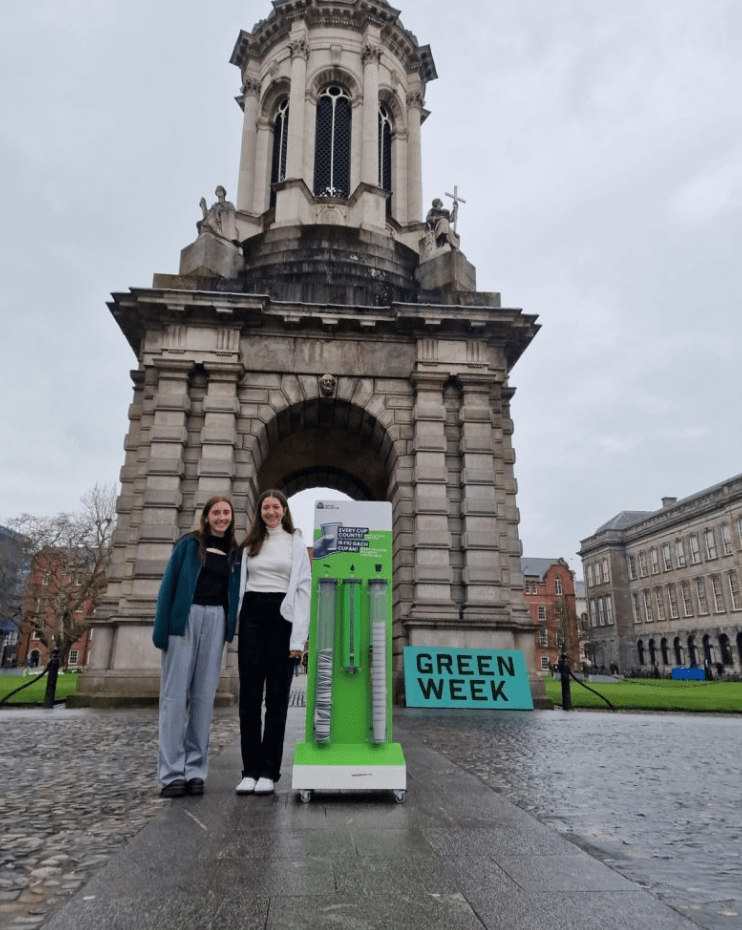
The Cup Collective is a waste management startup that offers a recycling system designed specifically for paper coffee cups. The company provides businesses with recycling infrastructure that separates cups, lids, and liquids. and then collects the cups. Once full, the cups are collected and shipped to the Rob Cropper paper mill in the UK, which is equipped to recycle these cups by separating the plastic lining from the paper cup. The cups are then upcycled into packaging for luxury goods. This represents a zero-waste system that enables circularity. The Cup Collective is currently being rolled out across Dublin and can be seen in coffee shops such as Insomnia by St Stephen’s Green, Butler’s in Ballsbridge, and now Trinity!
Circularity requires economic and environmental collaboration between the government and businesses. Education on waste management and appropriate infrastructure are essential if we are to tackle this issue, prevent single-use coffee cups ending up in landfills, and create a circular system.
 Evergreen trinity
Leave a comment