By: Michael Healion
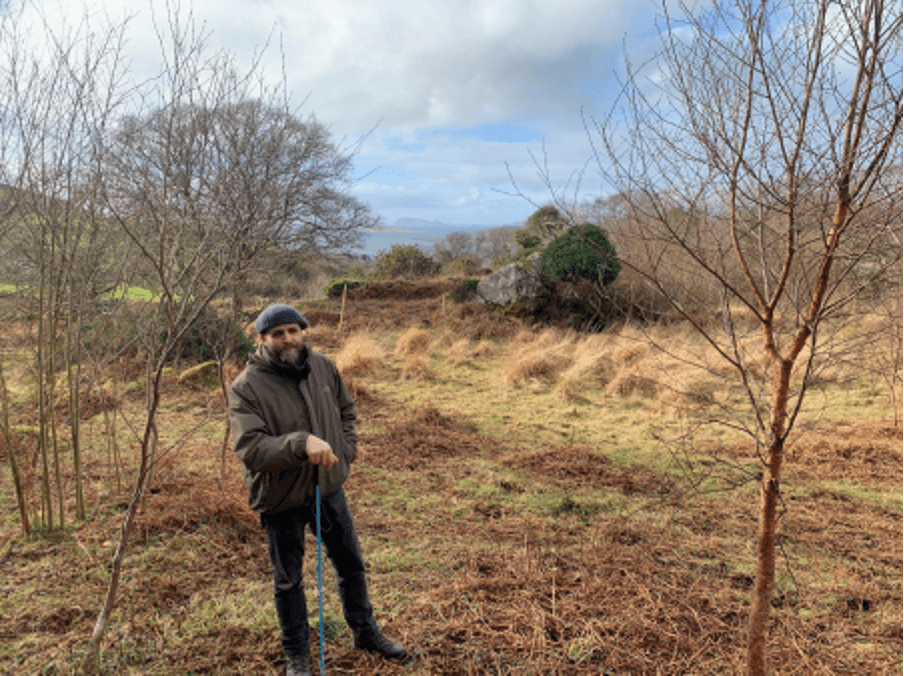
The topic of my current Master’s thesis at Trinity is how to educate about climate change. So, on a recent trip to the Beara peninsula, I could not pass up the opportunity to talk with Eoghan Daltun, whose important book on rewilding, An Irish Atlantic Rainforest, I had just finished. Eoghan was kind enough to show me around and discuss his work, accompanied by his friendly collie, Charlie.
Driving the Ring of Beara, although witness to spectacular scenery, I at first found it hard to imagine a rainforest in such a place. What I was seeing was mostly rocks and sheep, interspersed with green farmed fields. However, it was immediately evident on Daltun’s parcel of land that there was a greater abundance of flora here than elsewhere in the surrounding area, even in February.
For readers unfamiliar with “rewilding”, the term essentially means restoring a natural ecosystem, or allowing it to restore itself by not interfering. In his book, which was released in paperback form last week, Daltun charts his journey from the inheritance of a property in Kilmainham to the rewilding of his land in Bofickil (which derives from the wonderful Badh Fiadh-Choille in Irish, “Recess of the Wild Wood”), near the village of Eyeries.
In person, Daltun is a welcoming and patient host, answering questions thoughtfully and pointing out features of his woods. We stop and admire some young oak, ash and rowan trees as birds sing enthusiastically on a clear, mild day. Despite having grown up in the countryside, I am part of that generation that he identifies in his book, correctly, as “more cut off from nature than ever before”, a phenomenon I can also see in my students. This is tied to another problem in society, ‘ecological illiteracy’, which must be tackled. For example, many people believe that because it is green, Ireland is teeming with biodiversity. But as Daltun has written in The Irish Times and elsewhere, this is a misconception: Ireland is in fact one of the worst places in the world for nature. The Biodiversity Intactness Index, released by London’s Natural History Museum in 2018, placed the Republic of Ireland thirteenth from the bottom of all the countries in the world – one place ahead of Northern Ireland. It was not always such a man-made desert. Once, approximately 80 percent of Ireland was covered with woodland like that in which I was standing; now, tragically, the figure is about 1 percent.
We moved on to discuss the politics of the situation. This was only days after it had been reported that Atlantic Ocean circulation is nearing a devastating tipping point. We exchanged views on Naomi Klein’s book, This Changes Everything: Capitalism vs the Climate. Unsurprisingly, Daltun does not live as if in a retreat separated from the rest of the world: rather, he asserts that everything is connected. This is the greatest crisis that humanity has ever experienced. Societies need to be mobilised to face up to it, and instead, not enough is being done and so many companies push ahead in relentless pursuit of profit, heedless of biodiversity loss and climate breakdown. Nevertheless, Daltun is not without hope. He highlights how it is possible for a society to radically change direction. It has already happened right here in Ireland: look at divorce, gay marriage, abortion. These cases demonstrate that what was once a fringe position can become mainstream.
What actions can people take? Not everyone can embark on rewilding (many students at Trinity will be lucky to own any property in their lifetimes). But everyone can contribute in their own way. Satisfyingly, Daltun mentions Trinity’s wildflower meadows on College Green. This may comprise a tiny area, but they help to raise
awareness amongst all passers-by. We also bring up, of course, Greta Thunberg, who defies all assumptions of what an influential leader looks like and reveals the impact that one individual can have.
To finish, we touch on “Half-Earth”, the proposal of famed Harvard biologist E.O. Wilson that, in order to save 85 percent of the remaining species on Earth, half of the surface of the planet needs to be set aside as a human-free nature reserve to preserve biodiversity. Presently it is very difficult to envisage this coming about. Ireland, for one, is on course to miss its 2030 climate targets by a wide margin. However, we have no choice but to start from where we are. The French philosopher Voltaire once wrote that “no snowflake in an avalanche ever feels responsible”. Regardless of the enormity and complexity of climate change, we must each of us start to take responsibility and do something according to our capacity. Eoghan Daltun, with his temperate rainforest, has shown us one such path forward. An Irish Atlantic Rainforest: A Personal Journey into the Magic of Rewilding is out now in paperback. Daltun will release another book later this year. His Twitter and Instagram is @IrishRainforest.
 Evergreen trinity
Leave a comment